European elections – how does the voting system work?

I realised I didn’t have a clue how the voting works in the European elections, so as part of my dedicated efforts to make life just a little bit easier for all my loyal readers I researched it and now bring you the fruits of my labours.

Here in Oxford we’re part of the South-east Region. Ten MEPs will be elected to represent us. But you will only have ONE vote – one X on the ballot paper – on 22 May. You vote for a party not an individual. Each of the main competing parties has produced a list of 10 candidates (smaller parties may have fewer): candidates are elected in turn starting at the top of the party’s list. The candidates’ names will be on the ballot paper but there will be no other information about them – do your research first! Individuals can stand too, and the voting system treats them as if they were a party with only one candidate on the list.

Here is the official record of who is standing. The UKPollingReport website has a complete and also more colourful version giving some information about some of the candidates.

This is a mock-up of what the ballot paper will look like, courtesy of Southampton Council’s Returning Officer.
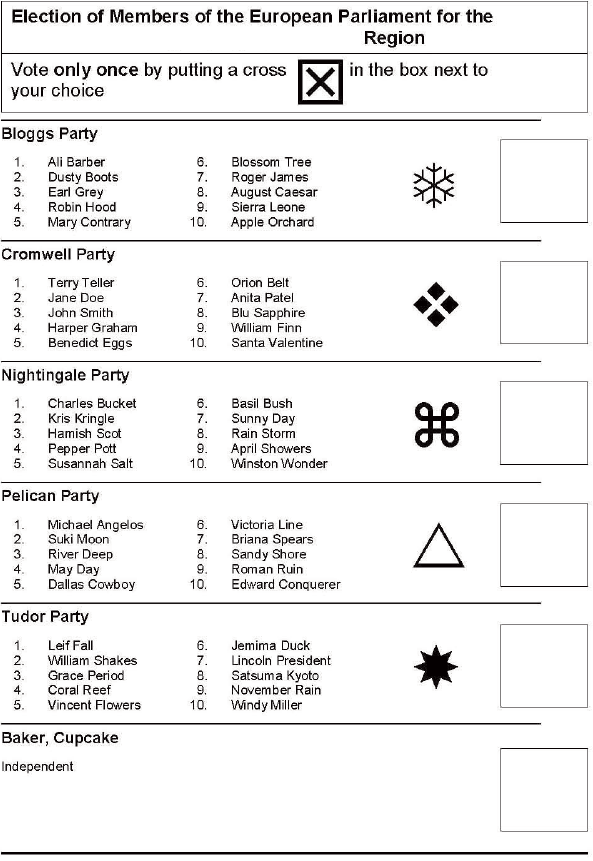

Click for larger version

So how does your one vote get transformed into 10 elected MEPs? Here’s how.

All the votes are counted. The first candidate on the list of the party with the most votes is elected. The number of votes for that party are then divided by a scale factor of 2. The party which now has the highest number of votes has their first candidate elected and their votes scaled by dividing by 2.

This process continues. If a second candidate is elected from a party’s list their original number of votes is now scaled by dividing by 3 (not 2). In fact every time a candidate is elected his/her party’s votes are scaled by first 2, then 3, then 4 and so on.

This table shows a simulated example.


Click for larger version

We start with the parties sorted by the number of votes they received. Party A has the most votes so their first candidate is elected, indicated by the red block. In the next column Party A’s votes are scaled by dividing by 2, meaning they now have 11728 counting votes. Party B now have the highest number, so their first candidate is elected (red block), and their votes are scaled down to 9333. Third place goes to Party C, fourth to Party D.

By the time we get to the fifth place, Party A’s scaled votes are again the highest number, so Party A’s second candidate is elected. Their original vote is now scaled by 3, becoming 7819. And so on, with following places going to Party B, Party A again, Party C, Party E (for the first time), and finally Party D.

So we end up with Party A having 3 seats, Parties B, C and D with 2 and Party E with 1, making ten in all.

So that’s it. Simple really, isn’t it?

Vote for Me! Candidates’ statements Ward by Ward

When the candidates for the City Council elections were announced on 25 April I started to look for their personal statements. Who exactly are these people who want our votes? Some of them are well-known: existing Councillors, habitual candidates – others are new to the scene and unknown.

I looked at all the parties’ websites. Labour had a near-complete set of personal statements. The others, nothing. The Greens have something for their existing Councillors, but the statements date back to the 2012 elections and haven’t been updated. Nothing on their new candidates. I searched for and found a very few personal websites for the candidates. Some have twitter accounts where their bios are more or less informative. I didn’t find any facebook pages with anything useful, though as a non-user of facebook I may have missed something.

I contacted all the parties’ local offices asking them for the information I wanted. The Conservatives and UKIP promised me something within a few days and were as good as their word. The Conservative website now has a complete set for all their candidates. UKIP emailed me details of all their candidates. The Greens have said they have prepared statements but can’t let me have them yet. The Oxford LibDems don’t seem to have a central contact point on their website. Local Councillors I know personally have sent me information but the set is not complete.

I’m astonished that the parties seemed so unprepared. I expected they would have all this ready to launch right at the start of the campaign. I imagined they would be putting their candidates’ details on their leaflets and flyers, and would have written them weeks ago. It’s as if they don’t think people will want to know anything about the candidates, that they will just vote for the party. I can see that this is more likely in a General Election, but locally I believe the person counts for a lot.

Anyway, here’s everything I have been able to put together by now, ward by ward (one page for each). The statements are the candidates’ own words (or their agents’). I have only edited out direct political point-scoring which has nothing to do with a candidate’s own qualities and beliefs. For a one-page list of the candidates and their twitter accounts see this page.

Personal statements ward by ward.

Candidates in Barton & Sandhills

Barton & Sandhills

Sallie Barnard (LibDem)
No information yet.
Van Coulter (Lab)
Trade unionist and co-operative member. Educated as a political economist at Ruskin College, Oxford. A humanist who supports consumer democracy, actions to address inequalities and seeks to uphold inclusion, believing that every person counts. Advisor to NGOs, trade unions & charities. Director of Ruskin College. Hobbies include economics, politics, international relations, public history and the arts. [1][2]
Raymond Hitchins (Green)
[Added 10/5/2014] I have lived in the area for the past 20 years. I work in the health service. I am involved with several local conservation groups. I am standing because I believe everyone should have the chance to vote green. [8]
James Johnson (Con)
Having lived in Oxford for three and a half years, James is keen to represent the residents of Barton and Sandhills and to strive to improve their lives through local government. He is interested in improving public services in the area, as well as to ensure that new housing and planning developments in Barton are well-managed and are positive for the ward. Over the next weeks and months, he’ll be listening to residents and working hard to understand and address their concerns. James is also a keen badminton player, is Deputy Director of a local charity, and enjoys films and reading.
On his twitter account James says he is a finalist at Oxford University and took a cardboard cut out of Eric Pickles around the USA.[3][6]
Bejamin Linus (Ind)
The system needs to change. Politics has stopped being what it is supposed to be, a mandate of the people. Society and community are my priorities. A happy community is a safer community. By bringing PEOPLE together, we can do more than make change, we can lead the way to the future. I am a staunch supporter of the power of community, and an even firmer believer in fairness, equality and democracy. Under my term, no-one will ever be able to say they didn’t get to be heard on an issue. Playing by the same old rules gets the same old results. We’ve all been worn down by lying politicians and their false promises. Isn’t it time to play a different game? The one that the establishment doesn’t even know exists yet? Vote for me – and watch our community grow and thrive.
On Ben’s twitter account he also says he is guitarist and producer from HashTag Alice, and Editor of Headington Monthly magazine.[4][5][7]
Ian Macdonald (UKIP)
I moved to Oxford 5 years ago as a student but my love of the city led me to stay here after graduation. I currently work as a software developer. I am standing because I am tired of inaction, complacency and failure among the ruling parties of Oxford. If elected, I want to challenge the culture of bureaucracy, waste and over-management in city hall and ensure that services delivered are of good quality and value. I will also put decision making back into the hands of local people by delivering referendums on major issues where enough people call for one. This is the only true mechanism for challenging out of touch politicians. [7]

Sources
[1] oxfordlabour.org.uk
[2] @vancllrvcoulter
[3] @jamesjohnson252
[4] @bad_gateway
[5] From personal statement on website.
[6] oxfordshireconservatives.com
[7] By email.
[8] greenoxfordshire.com