Cézanne and the Modern at the Ashmolean

I went to the Ashmolean the other day to see their current exhibition “Cézanne and the Modern”. It’s quite a small affair spread over three galleries but hardly crowded with exhibits. Cézanne himself is well-represented with a series of watercolours showing his style evolving towards abstraction, and making use of a restrained blue-green palette. In oils, the Mont Sainte-Victoire used as the exhibition’s featured image stands out. It’s one of many paintings he did of this subject.

As far as I remember (I didn’t take notes) other big name artists are represented by only one work each – van Goch, Sisley, Toulouse-Lautrec, Dégas, Manet – and two (or three?) Modiglianis. Of these the Sisley appealed the most to me.

But the exhibition did introduce me to two artists I didn’t know before. Three bronzes by Jacques Lipchitz impressed: a bust of his wife (said, I think, to be in Impressionist style), a striking Cubist “Acrobat on on a Horse” (left), and a powerful Jason wrestling a bull.

The other was Chaim Soutine, variously said to be Russian, Lithuanian and French. He certainly ended up in France where he did most of his work. He is represented in the exhibition by some portraits in oils, but the abstract landscapes he painted after discovering the Pyrenees are astonishing. Their visceral energy reminded me of Francis Bacon, although his colours are brighter and wilder. I read afterwards that Soutine also painted raw meat.


A Soutine landscape (not in exhibition)

The exhibition has one example of this – a painting of a (dead) hanging turkey. I wouldn’t want one of his landscapes in my home, but I’m pleased to have seen his work for the first time.

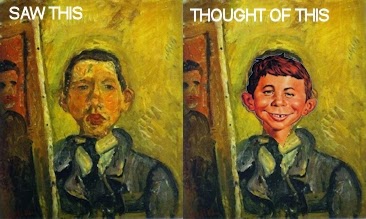
Oh, and I couldn’t resist illustrating my first reaction on seeing his self-portrait!
Stansfeld Outdoor Centre – a Community Asset?

The Stansfeld Outdoor Centre on land just off Quarry Road has been owned by Birmingham City Council since Canon John Stansfeld gave it to them in 1933. It has been used by Birmingham and by local Oxford schools and other groups for outdoor learning and recreation for all that time.

Birmingham City has decided it can no longer afford to keep the Centre going and will close it in July. It says it has not yet made a decision on the future of the site, but the obvious fear is that the land will be sold for development.

Friends of Quarry, backed by local councillors, are planning to apply to Oxford City Council to have the Centre listed as an Asset of Community Value. If they succeed it means that if Birmingham put the site up for sale the local community (presumably led by Friends of Quarry) will have six months to raise enough money to buy it themselves. Which begs the question if the site does come on the market, where’s the money going to come from to buy it? 20 acres of land within the Ring Road will be worth a fair bit. Oxford City might well be interested in the site for much-needed housing – it’s close to the Old Road Campus and the Churchill and Nuffield Hospitals after all, so would be an attractive proposition. What if Birmingham City applies for planning permission to build houses on the site? The price will soar.

Which all makes me think that however attractive it might be to keep the site as an Outdoor Education Centre, the realistic outcome is that the only people who will be able to meet the market price are Oxford City Council themselves, and what chance is there that they will prefer an outdoor centre to new housing?


Would the site get planning permission for housing? The Council’s Sites and Housing document doesn’t include the Stansfeld Centre. I think this means that there are no presumptions about its future use. Someone who knows the local planning situation better than I do can probably say.

Architecture Awards – three buildings shortlisted

In the architectural world the RIBA Awards are the equivalent of the British BAFTAs to the Chicago Athenaeum’s International Awards Oscars. For the RIBA awards, regional shortlists are whittled down to a national shortlist from which the eventual winner is selected.

Oxford is in RIBA’s South region and the regional shortlist has just been published. That there are three buildings in Headington on the list, all in the education/research sector, is confirmation of how important these institutions are to the local economy.

The Isis building by West Waddy ADP for EF International in Pullens Lane is phase 3 of a project which has provided a new main entrance to the campus, improvements to the administration and dining facilities, and the provision of a new lecture theatre for students on site.

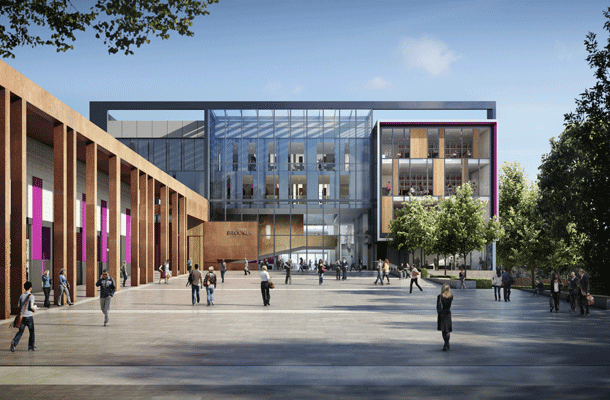
Design Engine Architects‘ John Henry Brookes building will be familiar to many of us, even though the builders are still on site. It includes a new library, lecture theatres, student services centre, teaching acommodation and commercial/retail space. Perhaps because the work isn’t quite complete the best picture I could find is the original artist’s impression.
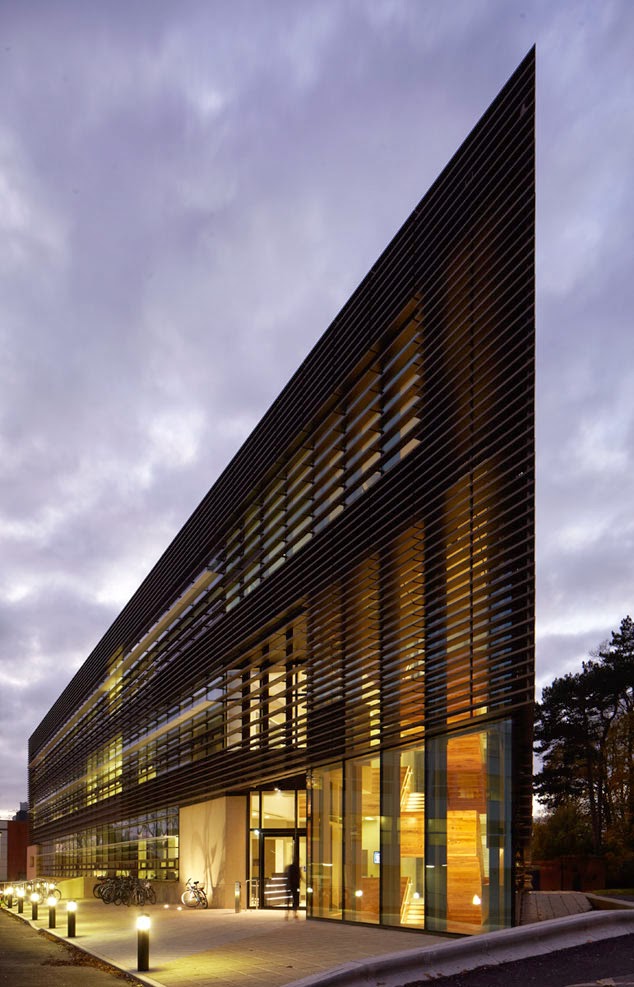
The Nuffield Department of Medicine Research Building is part of Oxford University’s Old Road Campus. Architects Make Architects have previously delivered the Old Road Campus Research Building and the Kennedy Institute of Rheumatology, which seems to make them the University’s go-to architects for the medical research sector. The new Nuffield building is an integrated, multi-disciplinary research centre which links biological science with medical application. The building has been designed to form the ‘head’ of the campus and create a strong presence for the department.
Pictures gratefully taken with acknowledgements from the individual architectural practices’ web sites.