Injunctions and blogging

Here’s a question for the lawyers. I’d be interested to hear any thoughts from those who study such things..

In this hypothetical case B has been charged with a serious offence and is being tried at the Crown Court. Local press, TV and radio are reporting the trial and it has aroused the interest of several local bloggers who are reporting proceedings and commenting on their blogs. B is found guilty and remanded for sentencing in a few weeks’ time.

During this period media coverage stops. The sentencing hearing (if it ever happened) is not reported. Some time later local bloggers, mystified, check the websites of the local press and broadcast media and find reports of the trial – and the conviction – have disappeared.

Six months later B is again on trial for the same offences. There is no mention in the media of the previous trial and conviction. B is found not guilty and acquitted.

The only explanation the local bloggers can think of is that between the original guilty verdict and sentencing B’s defence team have found a reason for the trial be to declared a mis-trial and have been granted an injunction to prevent the media reporting the original trial and conviction. This prohibition extends to requiring them (or the media’s lawyers to advise them) to delete all on-line references to the trial.

The question is, how are local bloggers expected to know about any such injunction? Presumably they are covered by it, and would potentially be in contempt of court if they mentioned the original conviction when reporting on the second trial. And presumably the court and/or B’s defence lawyers have well-established mechanisms for informing the papers, TV and radio stations. But given the spread of on-line reporting and commenting by people outside the mainstream, how does the court expect the existence and terms of the injunction to be brought to their knowledge? And if a blogger, in all innocence, mentioned the original trial and verdict, what could her defence be?
Deprivation Survey – How Does Headington Fare?

I came across some interesting data the other day about levels of deprivation in England. It’s from the Societal Wellbeing Theme in the Dept of Communities & Local Government’s (DCLG’s) Open Data Communities database. The Deprivation Indices 2010 have just been released: they are based on 2008 data so they show the situation 5 years ago. I have not yet found where you can see the detailed definitions behind the indices.

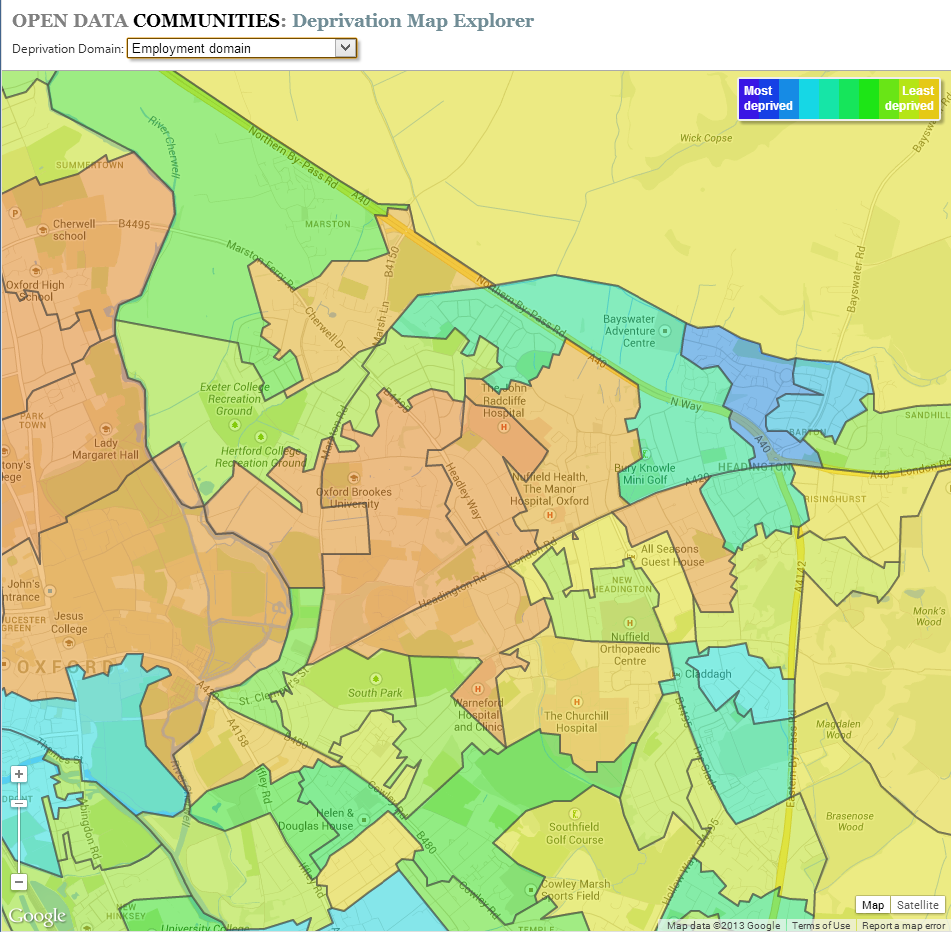
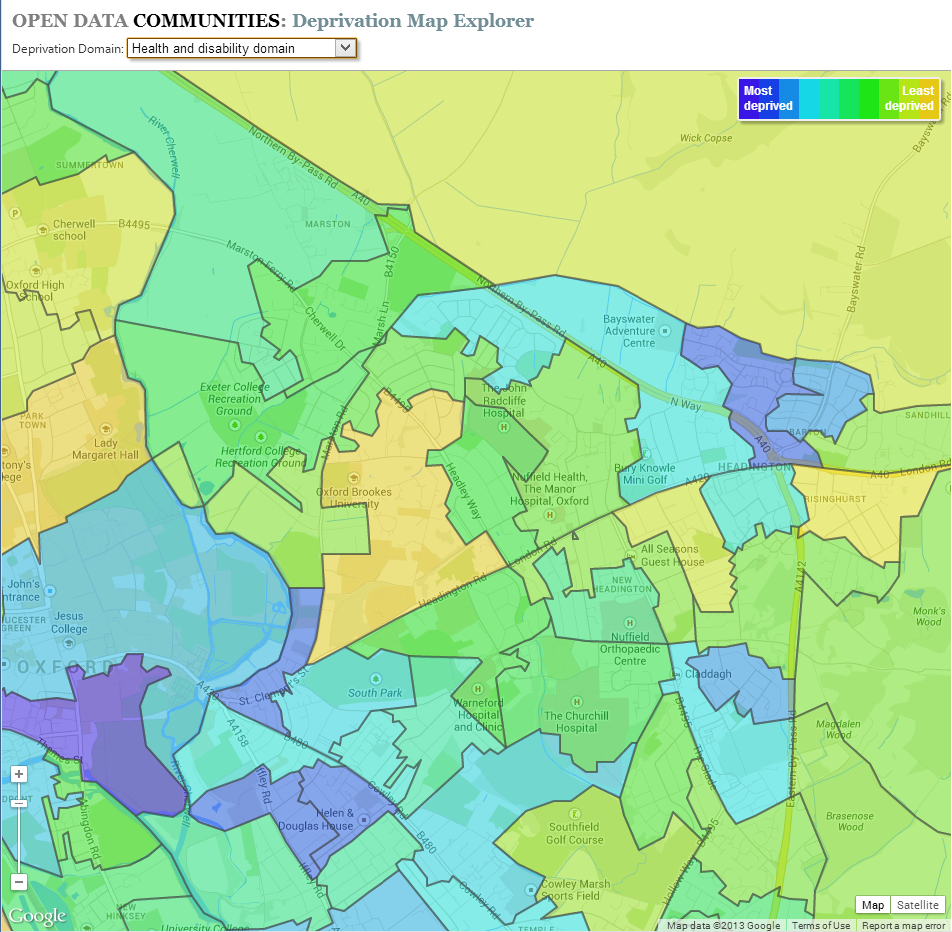
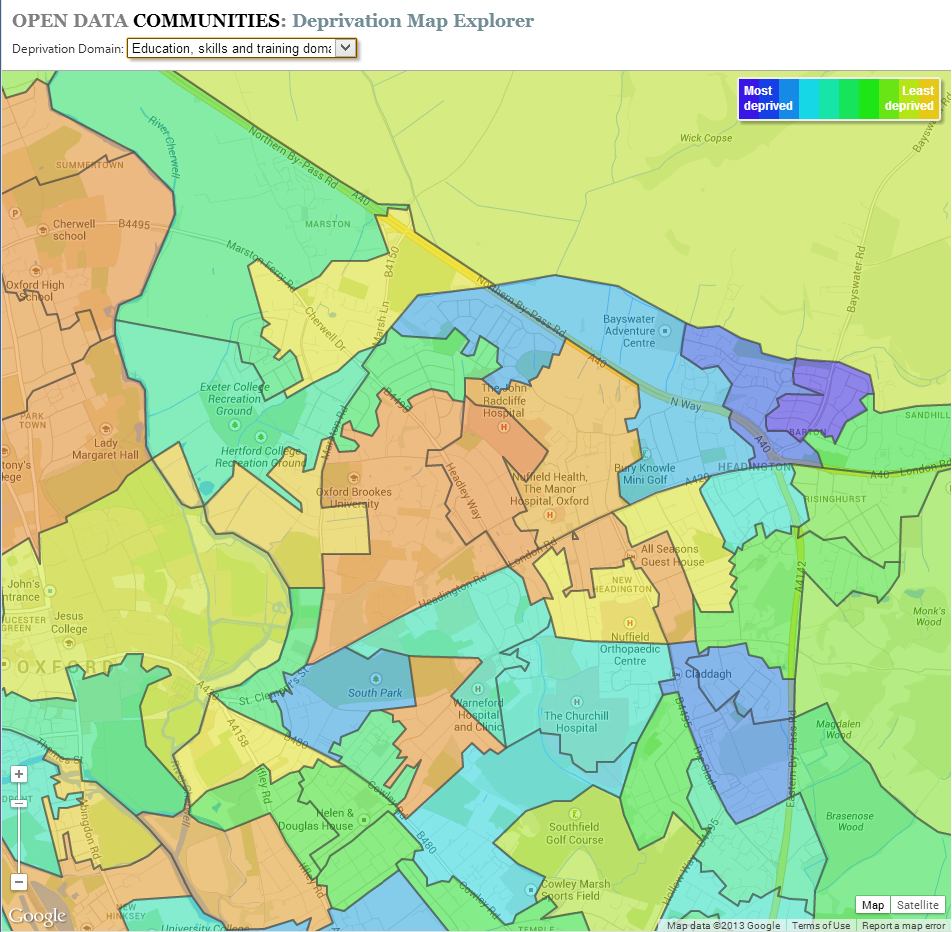
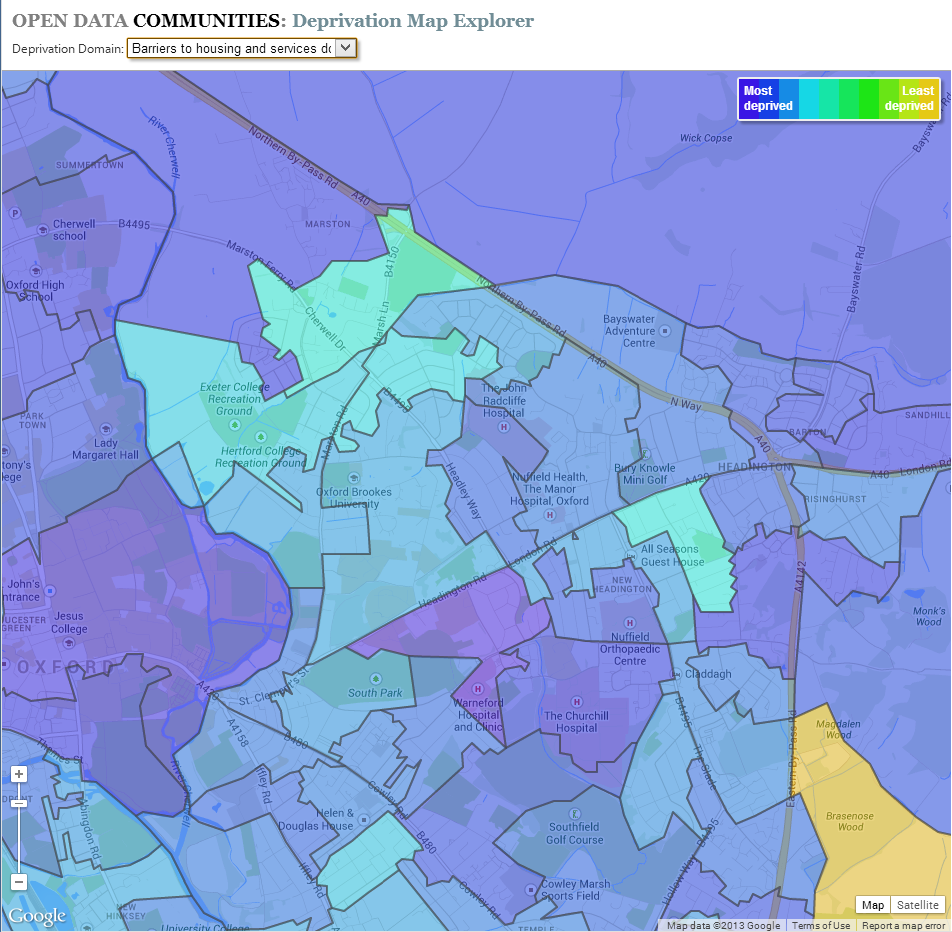
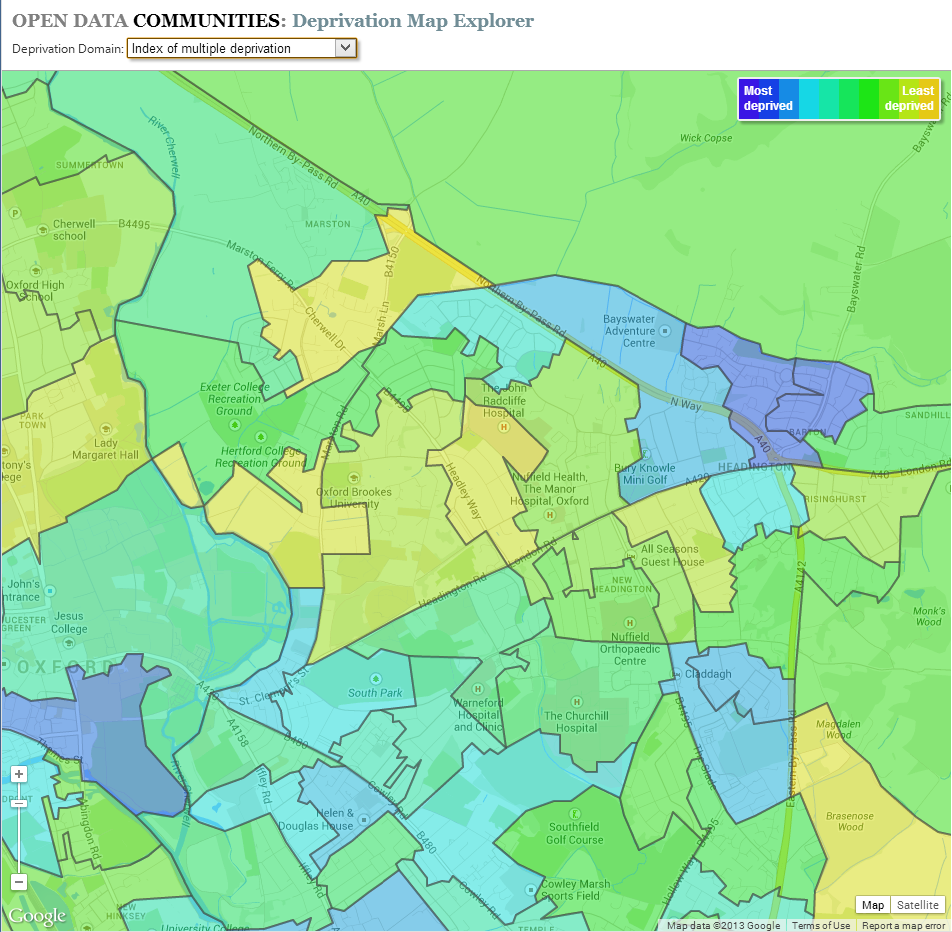
The data cover 32,482 areas in England. These maps show how each area is ranked. Clicking the thumbnails will get you a larger image, but to get the interactive maps where you can zoom in, pan, and see the results for any area you want, click here and enter a local postcode in the search box. To investigate the areas that make up OX3 I used OX3 9AH which is by the Headington traffic lights. This gets you to the Multiple Deprivation map. You get the other maps by using the drop-down menu box at the top left. Yellow areas are least deprived, dark blue most deprived. Click on an area to see its actual rank – the most deprived area has a rank of 1 and the least deprived a rank of 32482, so it’s better to live in an area with a high number than a low one.

Index of Multiple Deprivation

The Index of Multiple Deprivation combines 7 individual indices into one overall measure. The two areas covering Barton rank 4043 and 4096 out of 32482. Within the Headington/Marston/Barton area the least deprived part covers parts of New Marston and Northway and ranks 27552.

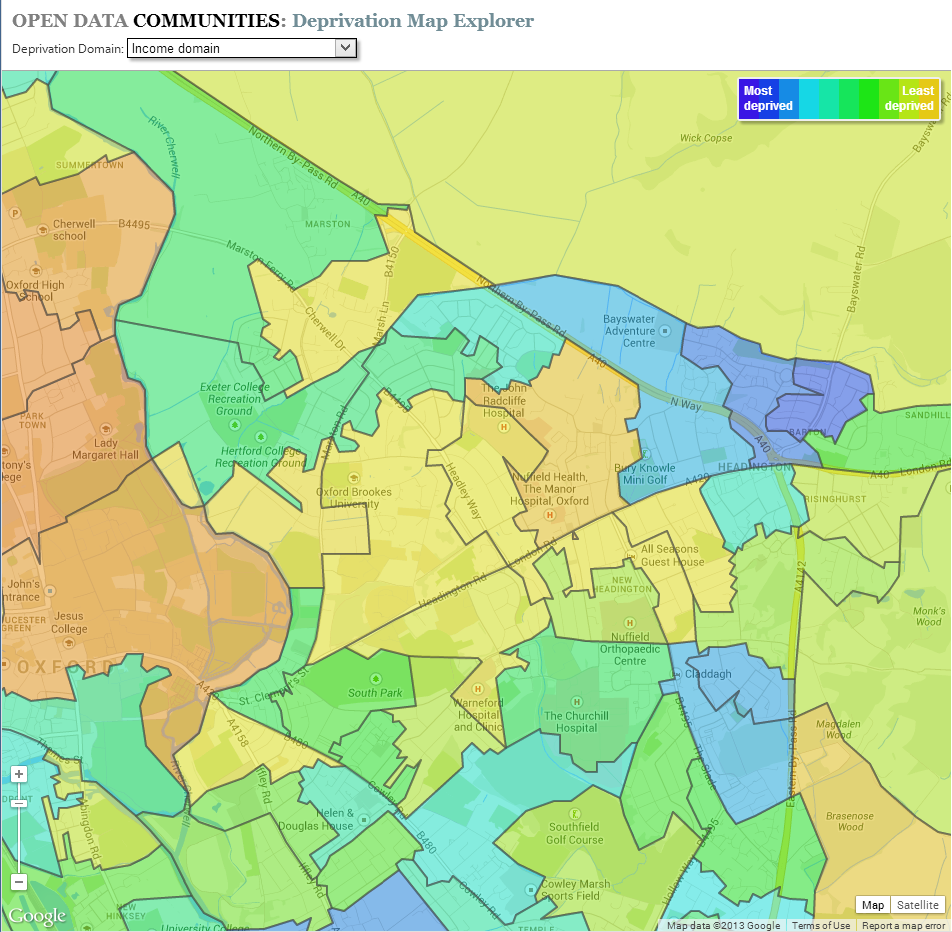
The Income data show a similar pattern. Barton ranks 3683 and 5097, while this time Jack Straw’s Lane is the least deprived, ranked at 28655.

For Employment, Health & Disability, and Education Skills & Training, the picture is similar, with Barton standing out in blue against the yellows and greens of other parts of the local area.

Income
Income
Employment
Employment
Health & Disability
Health & Disability
Education, Skills & Training
Barriers to Housing & Services


It won’t be a surprise that Housing (technically ‘Barriers to Housing & Services’) presents a very different picture. The whole of Oxford is blue or blue-green. Once again the New Marston and Northway area comes out best with a rank of 11169 while the area around Gipsy Lane and the Warneford Hospital ranks as the 108th most-deprived area in England.

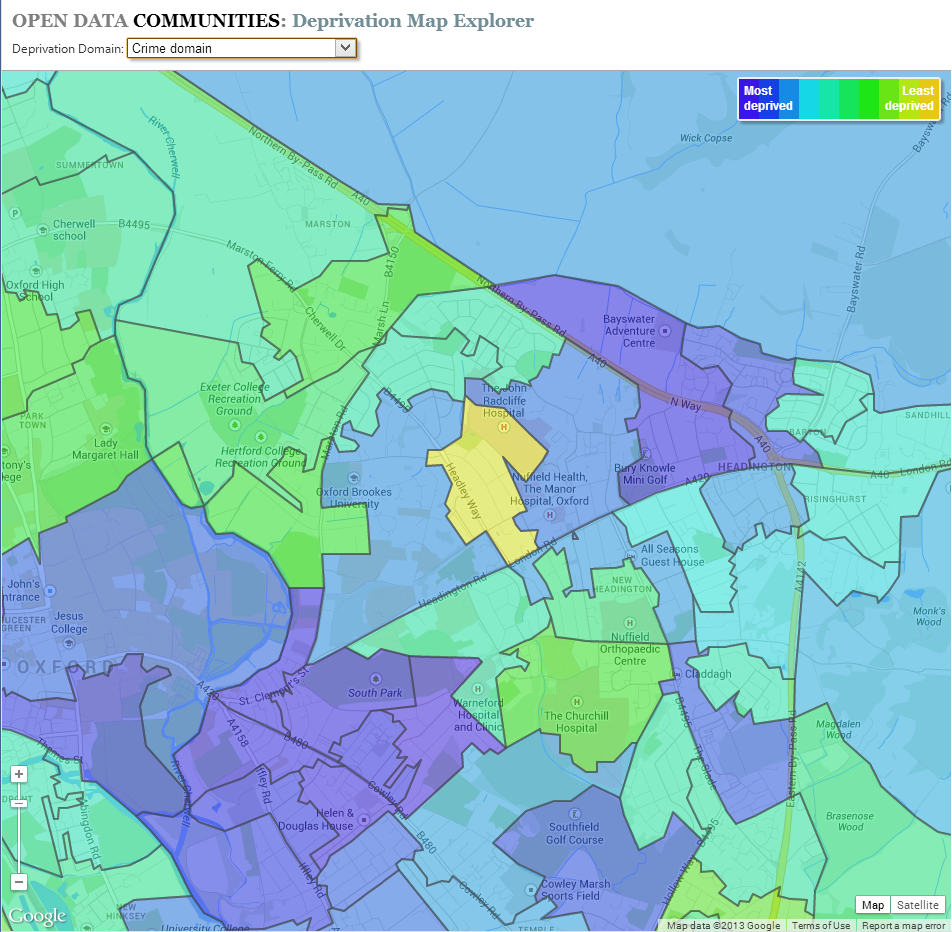
When it comes to Crime, OX3 comes off quite well compared to other parts of Oxford. The area north of the London Road around Barton Road, and over the A40 into the western parts of Barton is the most affected: it ranks 1275. The best local area on this measure is between Headley Way and the JR Hospital, ranking 27454.

Crime
Crime
Living Environment
Living Environment

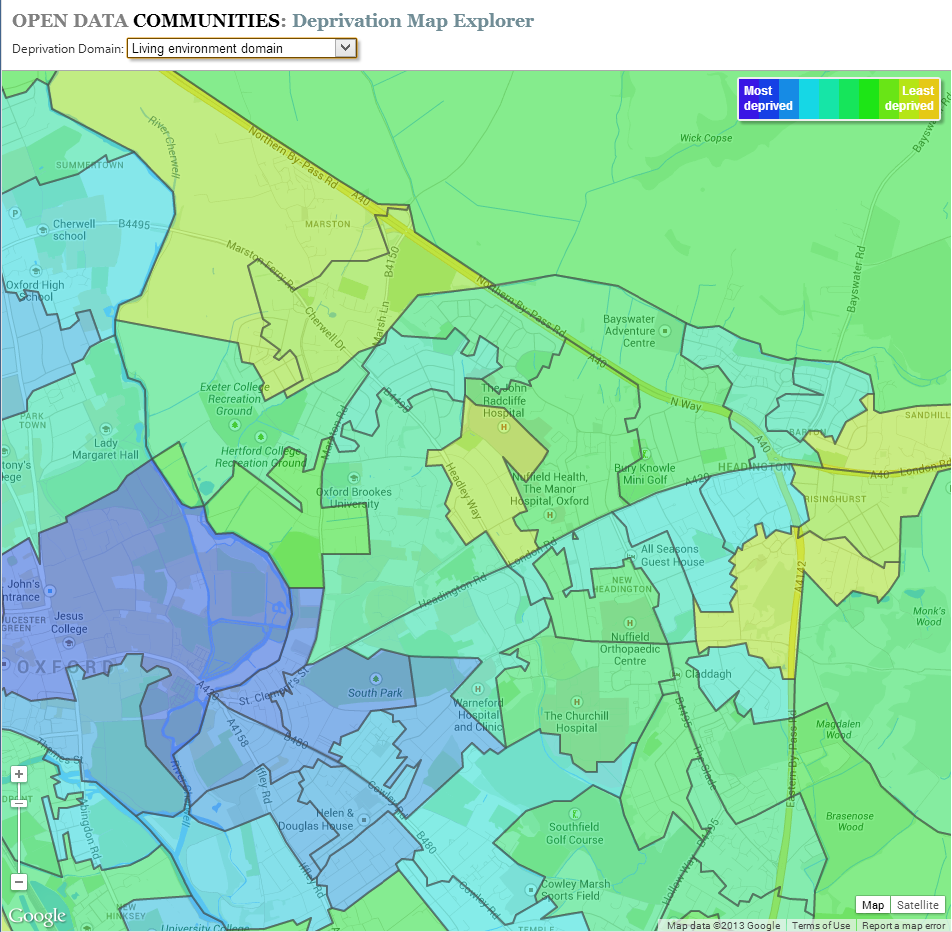
The last index, Living Environment, shows a better picture, with the most deprived areas in the centre of the city. The outer neighbourhoods of Sandhills, Risinghurst and Quarry rank in the low- to mid-25000s.

Although anyone might raise a quizzical eyebrow over some of the scores the individual areas are quite small and anomalous figures are probably just due to statistical variation. The maps do confirm what is already well-known, that on most measures there is a marked polarisation locally and in the City as a whole.

Where’s Headington’s Nearest Credit Union?

With credit unions in the news after Archbishop Justin Welby @abcjustin told pay-day loan company Wonga the Church of England would “compete them out of business”, I wondered how easy it would be for Headington residents to access a credit union.

A quick search found just two in Oxford. In case you didn’t know, one of the quirks of credit unions is that members have to have a “common bond”, which means something that links them together. This can be a postcode or group of codes, work (there is one for police officers for example), membership of a particular trade union, etc. Both Oxford ones are postcode-based, and the good news for those of us in OX3 is that the Oxford Credit Union is open to anyone living or working at an address with an OX1, OX2, OX3, or OX4 postcode. The other, the Blackbird Leys Credit Union, is only open to people with OX4 postcodes.

Both credit unions have an office in Oxford where transactions can be made. The Oxford Credit Union is in Temple Cowley, the Blackbird Leys Credit Union is in the Blackbird Leys Community Centre.

Other things you might like to know about Credit Unions (and I’m indebted to the FAQs on the Oxford Credit Union’s website for a concise summary of these points) is that their interest rates on loans are capped at no more than 2% a month (26.8% APR) compared to the hundreds or even thousands of percent charged by commercial pay-day loan companies. If you deposit money with them your savings are covered by the Financial Services Compensation Scheme and the Financial Ombudsman Scheme. Credit unions also offer free life insurance on all savings and loans. You can save from £2.50 a week upwards, to a maximum of £10,000. Interest on savings is set once a year at the Union’s AGM.

Links: Oxford Credit Union
     Blackbird Leys Credit Union (website under construction) or see creditunions.co.uk.